


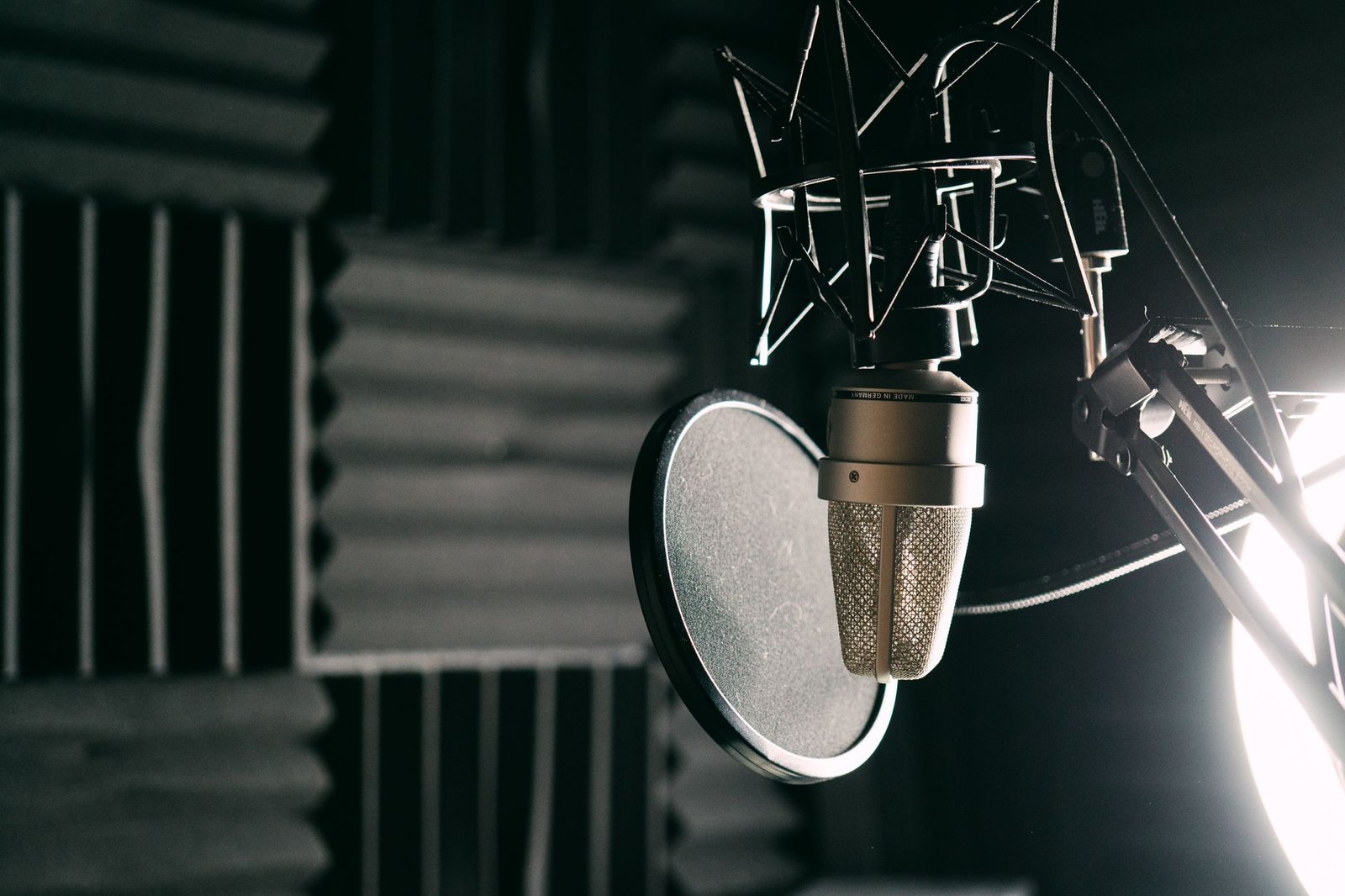
The first page of results on this question is a ranking. Ten models, stars, a winner. Those lists are not talking nonsense. They simply answer a question that comes fifth in the real order of things. An agency that listens to applications checks it every week: the same microphone reference produces usable files and files nobody can place.
The real order, seen from a control room
If you rank the factors that decide the quality of a take, from the most decisive down, the list looks like this: the room you record in, the distance and placement in front of the microphone, what you do with your voice, the chain that converts the signal into a file, and the microphone.
The microphone comes last. It counts, and it counts for less than the other four put together, because it only acts on what the other four send it. A microphone picks up what exists in front of it, an acoustic, a distance, an intention, then it passes the lot to a converter that will decide what survives.
That order is not an aesthetic opinion. It checks out by elimination. Change microphones in a bare room: the fault stays. Treat the room with the same microphone: the fault goes.
The room decides before anything else
Two distinct problems live in a room, and confusing them means treating the wrong one. The first is the noise that gets in: traffic, ventilation, neighbors, appliances on standby. The second is your own voice bouncing off hard surfaces and coming back into the microphone with a slight delay, that hollow corridor sound called reverb.
The two do not have the same cure. Against noise, the only real decision is the choice of room and the time of day. Against reverb, anything soft works for you: heavy curtains, rugs, hanging clothes, upholstered furniture. A full closet often makes a better recording space than a well equipped office.
The test that settles it takes one second: clap your hands in the middle of the room and listen to the tail of the sound. If it dies clean, the space is usable. If it hangs on, no microphone will repair that, and the most sensitive microphone will only document it in more detail.
This is the point that throws people most: a better microphone often makes a file less usable in an untreated room. What you hear then is not a microphone fault, it is a room fault.
Distance and placement: the setting people neglect most
The useful ballpark sits around 6 to 8 inches, 15 to 20 cm, to be adjusted for the voice and the microphone. Too far, and the room comes into the microphone along with you, which puts you back on the previous problem. Too close, and the voice thickens and every mouth noise becomes an event.
That thickening has a name: the proximity effect. Directional microphones, the ones that pick up mainly what comes from the front, boost the low frequencies as the source moves in. It is a tool when you control it, and the signature of an amateur file when you take it as it comes.
Speak slightly off the axis of the microphone rather than straight into it. The consonants that project air, p, b and t, otherwise send a puff that hits the diaphragm and produces a dull thump, a plosive, that the edit removes badly. A pop filter between the mouth and the microphone handles what is left.
Then there is consistency, which nobody mentions and which decides everything on a long text. A distance that drifts by four inches over a session produces joins that cannot be glued back together. A visual mark on the floor, or an arm set once and for all, beats a good intention.
What the microphone will never correct
Then comes what you do in front of it. Badly placed breath, a clenched jaw that clicks, an end of sentence swallowed because the air ran out at the start: a good microphone amplifies those faults, it never softens them.
Intention falls in the same category. A careful, clean read stays a careful, clean read, whatever gear captures it. Nobody has ever made a sentence convincing by changing diaphragms.
It is also why a technically modest file, acted right, places better than a flawless, dead one.
Between the microphone and the file, there is a conversion
A microphone does not produce a file. It produces a very weak electrical signal, which has to be amplified before it can be converted into data. That amplification is the preamp, and the conversion happens in an audio interface, the box that connects the microphone to the computer.
Two things play out there. The first is the amount of amplification available, the gain. The second is the self-noise of the preamp, the continuous hiss it adds to the signal, which becomes audible when you push the gain high to make up for a quiet source.
That has a direct practical consequence. Microphones with a low output level need a lot of gain, therefore a quiet preamp. Choosing such a microphone without looking at what feeds it means trading a room problem for a hiss problem.
One last piece of vocabulary: phantom power, marked 48 V on most interfaces. It is a voltage sent up the cable to the microphone. Some microphones need it to work, others do not. A silent take sometimes starts with a button nobody pressed.
Two families, two behaviors
The voice microphone market splits between two operating principles, and the real choice is made there, not between two references on the same shelf.
The large-diaphragm condenser
A very thin, very light diaphragm, held under an electrical charge, reacts to the smallest variations in pressure. The result: plenty of detail, a fast response, a definition in the top end that gives that impression of air around the voice. It is the standard of the treated booth, of dubbing and of fiction, wherever you want to hear the grain of an intention.
This microphone needs phantom power, it puts out a high level, and it faithfully picks up everything present in the room. Its quality and its flaw are the same thing.
The dynamic
A coil fixed to a heavier diaphragm moves inside a magnetic field and generates the signal directly. That mass makes it less reactive: less detail in the top end, a distinctly lower output level, and remarkable tolerance for loud sources.
Its virtue here comes from that inertia. A reflection coming back off the walls arrives weaker and less defined than a voice produced 8 inches away, and a less sensitive microphone reproduces it proportionally less. That is why radio studios and improvised booths get on with it so well: the dynamic plays down what an untreated room adds, where a condenser exposes it.
The trade-off is double. It needs more gain, so a clean preamp, and it needs you to work closer, so you have to manage the proximity effect and the plosives.
From the booth
On the files that reach us, we identify the room before we identify the microphone. Reverb and continuous hiss are audible in the first second, while the signature of a given model takes careful listening and almost never changes the decision. Another recurring finding: when two files from the same actor do not match up, the cause is far more often a change of distance or of time of day than a change of gear.
So which one should you choose?
The question turns around: describe your room, and the type of microphone follows.
A properly dead space, where the clap dies clean, leaves the choice open and lets a condenser do what it does well. A middling space, with some soft material and a short reverb tail, gets along with a condenser placed close to the voice, provided you watch the side reflections. An untreated space, a hotel room, a glass-walled office or a tiled living room calls for a dynamic and a short distance, without hesitation.
The polar pattern completes the picture. The cardioid pattern, sensitive at the front and deaf at the back, serves in almost every voice over situation, because it lets you point the back of the microphone at the most troublesome surface. A bare wall behind the microphone does less damage than a bare wall behind you.
As for the brand, it comes in once those three decisions are made: family, pattern, matching preamp. At that stage the gaps between serious models in the same family are real but fine, and they have more to do with the timbre of your voice than with any general ranking. The microphone that flatters a settled baritone does not do the same favor for a bright, fast voice.
What the studio listens to, at the end of the chain
A casting agency never listens to a microphone. It listens to a voice, and it notes in passing whether the chain carrying it is clean: no reverb, no hiss, a level held, no processing pasted on to hide a fragile take.
If you have to invest your attention somewhere, put it in this order: the room, the distance, the acting, the preamp, then the microphone. It is the only hierarchy that checks out on listening, and it is the one we apply in the booth, in voice direction and sound engineering.
When that chain holds, your application becomes usable, and that is the condition that counts. The FRVOICEOVER casting brings together more than 100 voices, in every style and every age, and it stays open. If your file passes the clap test, if your level is stable and if your voice arrives with nothing laid on top, send it on the join the catalogue page. If not, take the room again first: it is the only item where the work shows immediately.
Room treated, level stable?
An application to the FRVOICEOVER catalogue gets judged on the take itself, not on the microphone model. Send a file that lets your voice through with nothing laid on top.
Send a usable takeRead also
- What your room has to hold before your microphone: the room comes first in the order described here, and this is what it has to hold before any purchase.
- What a casting agency listens for in a demo: once the take is technically clean, it gets judged on other criteria, and those are the ones that sort.