


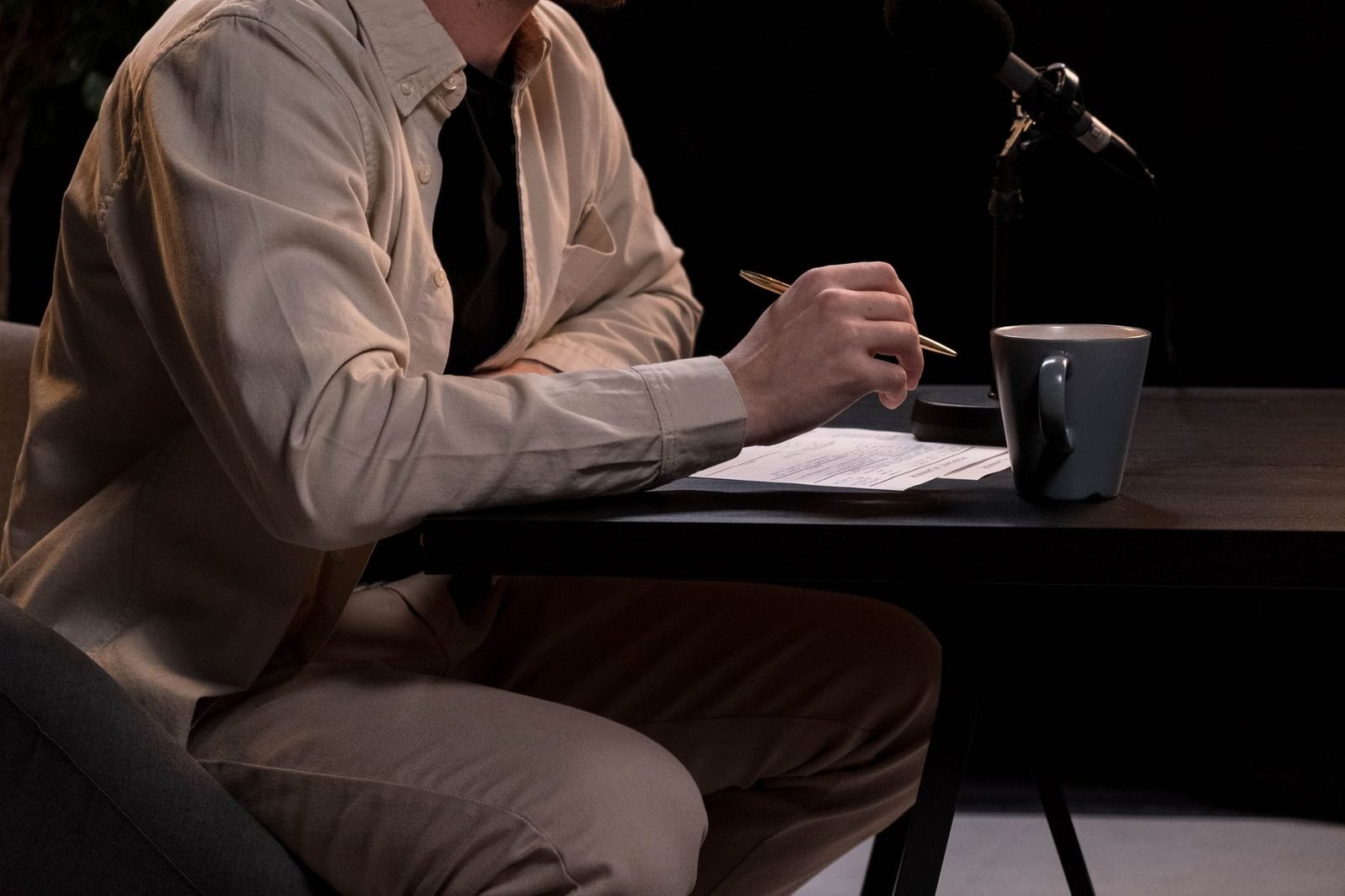
A commercial script reads beautifully on screen and falls apart at the microphone. Seven seconds too long. One sentence no actor can get through on a single breath. A brand name whose pronunciation nobody signed off. The copy was good. It simply was not written to be said.
The gap has a cause, and it is not the voice. Writing for the eye and writing for the ear are two different jobs, and only one of them has a stopwatch running.
So here is how to write a commercial script that holds up at the microphone: what the format costs in words, what reads well and sounds wrong, the structure that survives a short format, and what an actor needs written down.
You think you are writing a message. You are writing a duration.
A commercial starts with a constraint before it starts with an idea. Fifteen, twenty, thirty or forty-five seconds: the format is bought before the first line exists, and it is not renegotiated the night before the session. Everything you write happens inside that box. In the trade you will hear a thirty or a fifteen as often as the full name. The shorthand is friendly; the edge of the box is not.
Out loud, seconds are counted in words, and the count moves with the tone, the actor and the language. That arithmetic has a piece of its own, on words per minute and the benchmarks per format, and our ScriptTimer does the math for you. Assume that pass is done before you read on.
The only reliable measure is also the simplest. Read the script out loud, stopwatch in hand, at the tempo of the tone you are asking for and not your own. Do it twice more. If the three readings do not land in the same second, the text is not calibrated.
Two line items get forgotten almost every time. Mandatory disclosures first: in several sectors the wording is fixed and cannot be shortened, so budget them in seconds before you write the body of the message. Silences second: a stop before the payoff, a breath after the brand name, a beat before the music tag. They make a message audible, and they take up room.
“You cannot say everything in twenty seconds.” Correct. That is what the format is for: it makes you choose what stays. Going from a thirty to a twenty is not a trim, it is a rewrite. A spot carrying the script of the longer format is audible in the first second: the actor speeds up, the intentions flatten, and the listener keeps the rush.
What reads well and sounds wrong
The eye rereads. The ear does not. That single fact separates an advertising script from every other piece of copy you write.
Five families of problem turn up in almost every script that reaches the booth.
Stacked subordinate clauses. A sentence carrying two relative clauses and an aside is understood on the page and lost in the ear. Out loud: one idea per sentence, and the verb as early as you can get to it.
Acronyms. An unfamiliar acronym is heard as a string of letters with no meaning, and the listener tunes out for the two seconds it takes to decode. “Ask your dealer about the ADAS package” hands the ear four letters and a safety system in half a second. Either give the letters an intention of their own, or say what the thing does: the driver-assist package.
Complicated figures. “23.7%”, “from February 14 through the 28th”, “1,847 items in stock”: what the eye takes in at a glance is said slowly and forgotten immediately. Round it, or turn it into a ballpark figure.
Alliteration you did not plan. “Our best stainless steel set” offends nobody on the page. At the microphone the stacked s and st make the actor stumble, and they pull attention onto the mechanics of the sentence instead of the offer. Read the script back listening to consonants, not words.
Collisions at the word boundary. English has no liaison in the French sense, but it has something just as awkward: consonants piling up where two words meet, and vowels handing over with nothing in between. “Next steps start Tuesday” makes the mouth reset three times in four words. “Free entry, easy exit” hands one vowel straight to the next three times in a row, and forces the actor to glue them or chop the phrase. Moving one word usually settles it.
Add the sound ambiguities, which exist only out loud. “Fifteen” and “fifty” are the classic pair on air. “Our site” and “our sight”. “For” and “four”. On the page there is no doubt. In a spot the listener decides alone, and sometimes decides wrong.
A commercial script rewritten: before, after
Take a generic sentence, the kind that turns up in a first draft for a coffee brand.
Before, written for the eye:
Thanks to a slow roasting process that protects the natural aromas of beans selected from the finest high-altitude plantations, our coffee delivers an incomparable taste experience from the very first cup.
After, written for the ear:
Slow roasted. Beans picked one at a time. And from the first cup, the aroma is all there.
The message has not moved. Its breathing has. A thirty-one-word sentence becomes three short units, each of which fits on one breath. “Incomparable taste experience” is gone: those words survive on the page and break at the microphone. The superlative about the plantations went because it proves nothing and costs a second. What is left is thirteen words shorter, several seconds handed back to the silences, and three landing points an actor can play.
Run the exercise on your own script: take the longest sentence, say it out loud, and cut where you had to breathe.
From the booth
Fifteen years in the booth and roughly 3,000 projects later, one observation keeps coming back: the first take is often the best one. It has the freshness, it is not over-controlled yet, and in the edit we return to it more often than expected. When an actor stacks take after take on the same sentence, the problem is rarely the voice. It is a line nobody said out loud before sending it, or a brief with no intention written down.
The structure that holds inside thirty seconds
Most spots run on the same three-part skeleton. It holds because it stays legible when there is no time.
The open. The first seconds decide whether the rest is listened to or endured. A question, a situation the listener recognizes, a sentence that moves a familiar idea sideways. What fails almost every time: opening on the brand name, or on a generality everybody has already heard.
The middle. A problem the listener recognizes, an answer addressed to them, one benefit. A short format does not forgive accumulation.
The payoff and the call to action. It gets written last when it should be written first, because its wording is often imposed: brand name, web address, offer end date, mandatory disclosure. Count that block first, then write the rest with what is left.
Radio, and the formats with no picture
A radio ad script adds one constraint: no image will rescue a vague sentence. What the listener sees is whatever your words make them see, with concrete nouns, sounds and silences. The script is judged on what it sets off in the head of somebody whose hands are busy.
Two practical consequences. Write the sound intentions into the script itself, at the exact point they happen: ambience, effect, music turn, the moment the voice returns. And keep the brand name out of the dense passages, because a name spoken inside an audio traffic jam is not remembered.
On television the opposite fault dominates: the copy describes what the picture already shows. A voice over that repeats what the viewer can see spends seconds for nothing. It is there to say what the picture cannot show.
What a voice actor needs from your script
Script writing for voice over carries one rule the page does not: somebody else says it out loud. A point of vocabulary first, because the confusion costs time in briefs. On a commercial, the craft you are hiring is voice over: carrying a message and holding one intention, with no existing performance to match. Dubbing is a neighboring and separate craft, where the voice has to agree with the lips and the acting of somebody already filmed or animated, with its own synchronization constraints.
An actor does not read your text, they interpret it: they decide where to breathe, where to lean, where to let a line fall. The more the script tells them, the less they guess. Four things genuinely change how a session runs.
The intention, in writing. Not “dynamic tone”, which means nothing. Write what the voice is doing: it reassures, it lets you in on something, it states a fact, it is amused by the obvious. Three precise adjectives at the top of the script are worth an hour of retakes.
Where it will play. National radio, local radio, television, pre-roll, podcast, in-store announcement: the channel changes the energy level, where the voice sits and how it is treated at the mix. Say what will be under the text too, music or ambience, and at what moment.
What you specifically do not want. The most useful instruction, and the rarest. “No hard-sell tone.” “Do not smile on the last line.” “Nothing that sounds like a movie trailer.” One clear prohibition removes, in a single stroke, the proposals that would cost you half a session.
How the names are pronounced. Brand name, product name, places, foreign words, acronyms. Write the expected pronunciation in plain phonetics, next to the word, inside the script and not in a separate email. A skincare line called Aveline is AV-uh-lin to one half of the room and av-uh-LEEN to the other, and both halves are certain. A French product name in an English spot doubles the question: does the actor say Maison Roux the French way, or the way your customers ask for it in a store? Settle it before the session. A mispronounced name is repairable in the edit when the right take exists, and a new session when it does not.
The same questions drive the casting: which color of voice, what perceived age, what energy for this channel. We go into them on our commercial voice over page. On a multilingual campaign the calibration is redone language by language, because a translated script almost never runs the same length as the original. That coordination is the work of a voice over agency.
The mistakes that make a session overrun
- Information overload. Three benefits, two offers and a date: the listener keeps none of them. A spot carries one message. The rest belongs on the landing page.
- A vague call to action. “Visit our website” says neither what to do nor when to do it. Name the action, the place and the deadline.
- The drowned brand. A spot everybody remembers without knowing whose it was has missed its target.
- Copy that was never said out loud. This is the mistake that contains all the others, and the only one you can fix in fifteen minutes.
Before you send the script
A commercial script does not get approved in a shared document. It gets approved standing up, out loud, stopwatch in hand, with the intention noted in the margin and the pronunciation of every proper noun written down. That quarter of an hour is the difference between a session that fits its slot and one that overruns.
Well-written copy can still miss out loud. If you have a script in progress and a format to hold, talk to us before the booth: we read the copy, the channel and the deadline, then tell you what works at the microphone, what needs rewriting, and which voice carries it. Get a quote.
Your script deserves to be heard
Well-written copy can still miss its mark out loud. Send us yours: we will tell you how it sounds, and which voice should carry it.
Get a quoteRead also
- How many words per minute? Timing a script before you record it: check that your text fits the format you are aiming at
- How to record a voice over: the method, and what a studio changes: what happens next, in the booth