


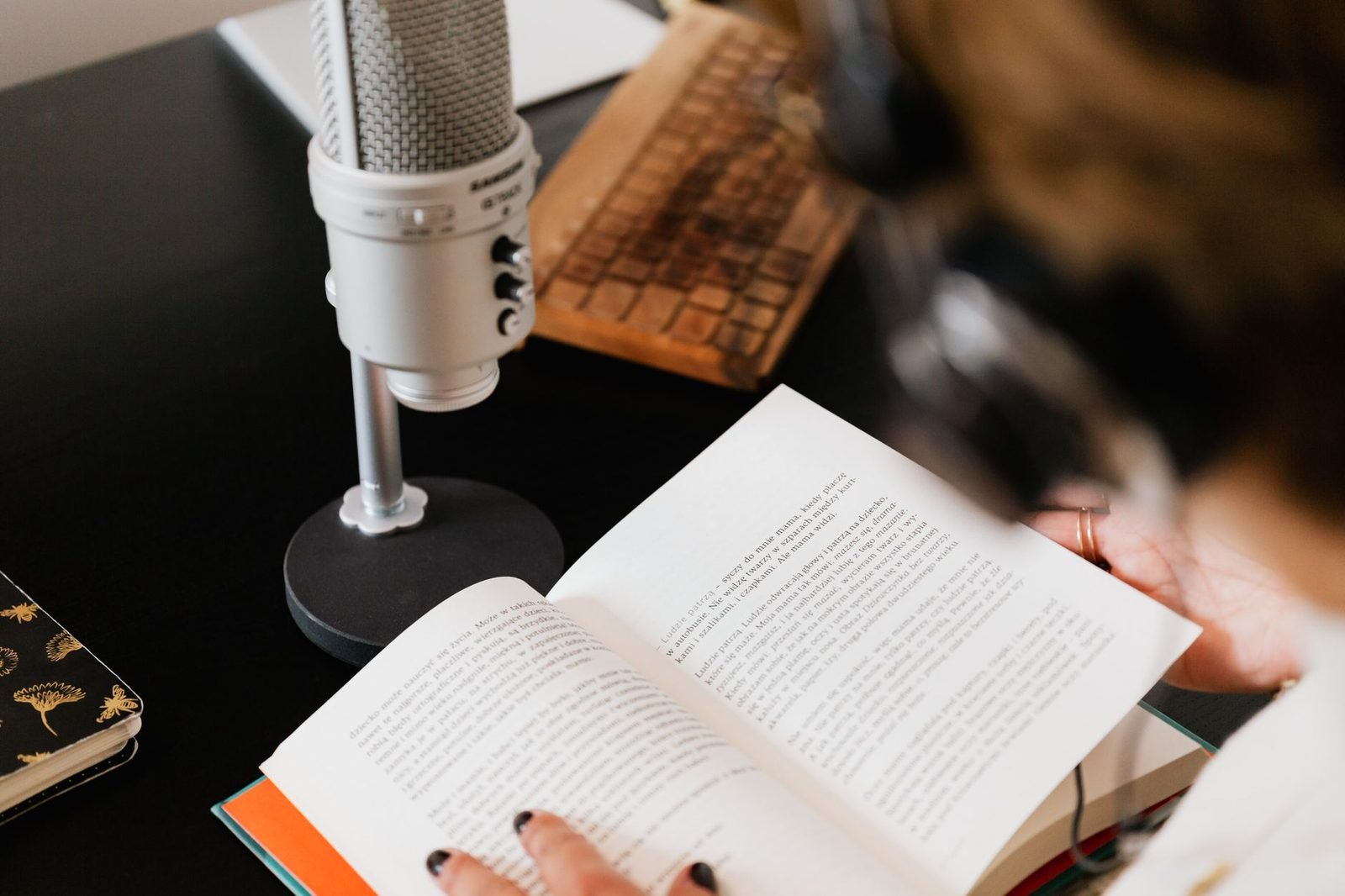
A signed-off manuscript gives the false impression of a finished project. The text exists, it has been proofread, all that is left is to say it out loud. That is precisely where schedules start to slip, because the part you have just finished was not the heavy one.
One hour of listening does not get produced in one hour
You think you are commissioning a reading. What you are starting is a chain that will occupy an actor, a booth, a voice director, an editor and a proofer for several weeks.
Recording an audiobook is not producing a long voice over, it is running a production project with its batches, its milestones and its pickups. The difference is not the microphone: anything decided badly at the start gets paid for multiplied by the number of chapters.
Count several hours of work for every finished hour of listening delivered. That is a working benchmark, not a rule: the ratio depends on the density of the text, the number of characters, the terminology that has to be locked down, how experienced the narrator is in long form, and how demanding the final check is. A clear, linear essay does not get produced at the same pace as a six-voice novel packed with foreign names.
This is why the trade counts in finished listening hours. The unit surprises people, then it makes sense: it measures what the listener receives. Billing studio hours makes the client carry risks they do not control: a hoarse voice, a stubborn sentence, a technical incident. The finished listening hour moves that risk to the side of whoever is producing, and it makes two proposals comparable.
Preparing the text, the stage almost nobody budgets
The text has to arrive in the booth prepared, not discovered. That phase is run calmly, with the author, and it governs a good part of the schedule.
Proper nouns. Every name of a person, a place, a brand, a dish, a plant, needs a pronunciation settled and written down before the first session. Without that, the narrator invents, and they do not invent the same thing three weeks apart. A pronunciation glossary approved by the author is the single document that saves the most time on an audiobook production.
Foreign words and quotations. Are they said the way the narration language would say them, or in the original language? The answer depends on the narrator, on the character speaking and on the readership. It is decided once, for the whole book, and written down.
Dialogue. How many characters speak, and which of them have to sound different? A narrator does not manufacture ten voices. They hold colors: a register, a speed, a placement, a way of ending sentences. You choose which ones, record them as a reference, and be able to reproduce them exactly at the twelfth session.
Footnotes. Out loud, they do not exist. Three treatments are possible: fold them into the flow of the text, group them at the end of the chapter, or leave them out. The choice belongs to the author and the publisher, it is editorial before it is technical, and it has to be settled before the studio.
Titles, epigraphs and unreadable elements. Do you announce chapter numbers? Do you read epigraphs and dedications? What happens to tables, diagrams, web addresses? One uniform rule beats a chapter-by-chapter decision.
This work looks like admin. In session it turns into hours saved.
Choosing a narrator: stamina before timbre
This is the most frequent misreading in casting. You listen to a demo reel, you land on a beautiful grain, you sign. A voice that seduces over one minute can become hard to bear over a whole book.
What tires an ear in long form is rarely the timbre. It is a musicality too marked that returns at the end of every sentence, an attack that is always identical, a breath audible in the same place, a mannerism you do not notice at first and can hear nothing but by the third chapter. So the casting question becomes: does this voice let itself be forgotten?
An audiobook narration casting is run differently from a spot casting. Have a long passage read from the middle of the book, never the opening, which is always the best worked. Ask for a page of dialogue and a page of description, the two regimes of the book. Then listen to the end of the audition before the beginning: that is where stamina shows. Finally, check real availability across the period, because a narrator who disappears for a month in the middle of a book is a production problem, not a hitch. This is one of the points where working with an agency changes the result: it has already heard these voices hold over the distance.
Consistency, the real technical challenge of the format
An audiobook is built across spread-out sessions, sometimes weeks apart. The listener will never notice that a session went well. They will hear the join immediately.
What has to stay identical from one day to the next: the room, the capture chain, the mic position, the recording level, the pace, the acting energy and the color of each character. Moving a few centimeters away from the mic is enough to change the presence of the voice, and the seam is audible. A studio handles that with discipline: the position is documented, the settings are written down, and a reference extract is played back before the first take of every session.
It is also why a fragmented self-production rarely gives a publishable result. You record at weekends, in a room whose furniture changes, with a mic that gets put away between sessions, over several months. The result is audible chapter by chapter. Talent has nothing to do with it: it is a reproducibility problem.
From the booth
On an audiobook, fatigue shows in sentence endings that drop and in articulation loosening on the long words, well before the timbre moves. The actor does not feel it yet, the control room already hears it, and that is the moment to impose a five-minute break instead of grinding at a paragraph. The counter-intuitive reflex of long form: you reduce the number of takes instead of increasing it. The first is almost always the most alive, and it is the one kept in the edit.
The edit, then the line-by-line check
The edit removes from the story what is not part of it: mouth clicks, saliva noise, turning pages, chair creaks, breaths that push too hard. Not every breath. A reading with no air sounds dead, and the balance is judged by ear, chapter by chapter. The silences between paragraphs and between chapters are the same work: they carry the rhythm of the book and get set deliberately, they are not something you put up with.
Then comes the match between sessions, where level and color are aligned so the recording days disappear. Then quality control, the item schedules always forget.
That check means listening to the entire book at real speed while following the source text. You are looking for skipped words, changed words (a singular become plural, one first name taken for another), sentences read twice, pronunciations that have drifted between chapter three and chapter eleven. A detail of the trade: that proofing does not belong to the narrator. They hear what they meant to say, not what they said.
Deliverables: one file per chapter, inside an imposed frame
A distributor does not receive one long file. It expects a chapter-by-chapter split, an ordered naming scheme, an opening and a closing announcing title, author and narrator, and files set inside a loudness window with background noise under a given ceiling, a defined format, and silence at the head and tail.
These specifications differ from one platform to another and change over time. The only reliable method is to get the official technical document from the distributor you are aiming at before the first session, and build the production onto it. A rejected batch gets redone at source, and it is the heaviest pickup in the whole project, since it covers the entire book.
Rights: audio is a separate use
Adapting a text into an audiobook is a use distinct from print publication. Adapting and reproducing a work without the author’s consent is unlawful (article L122-4 of the French intellectual property code), and an assignment is valid only if each right assigned is mentioned separately, with a field of exploitation delimited as to scope, purpose, place and duration (article L131-3). In other words, if the publishing contract does not separately mention audio, audio was not assigned.
The narrator’s voice falls under a parallel regime. Fixing their performance, reproducing it and communicating it to the public require their written authorization, and assigning their rights has to come with appropriate remuneration (article L212-3). That is settled in the contract, before the session, and it also covers the derived uses people think of too late: promotional extracts, a trailer, social media, re-releases.
What to settle before the first session
An audiobook is decided on the schedule before it is decided on the voice. Five answers are enough to secure the rest: the pronunciation glossary, the number of characters genuinely distinguished, what happens to notes and unreadable elements, the distributor you are aiming at with its technical specs, and the written scope of the audio rights.
You have a manuscript and a release date? The most useful thing at this stage is a scoping conversation. The audiobook voice over page describes how we produce this format, and the quote form lets you describe the project in a few lines: length of the text, number of voices, intended distributor, deadline. We come back with a production plan and a schedule that holds.
A book to carry into audio?
Tell us the length, the deadline and the intended use: we scope the casting, the session schedule and the rights before anything starts.
Get a quoteRead also
- How to record a voice over: the method, and what a studio changes: what happens during a directed session
- Voice over buyouts and usage rights: what you are actually buying when you commission a voice: the rights attached to an audio use